
A DEATH
HAS OCCURRED
September 21, 2026
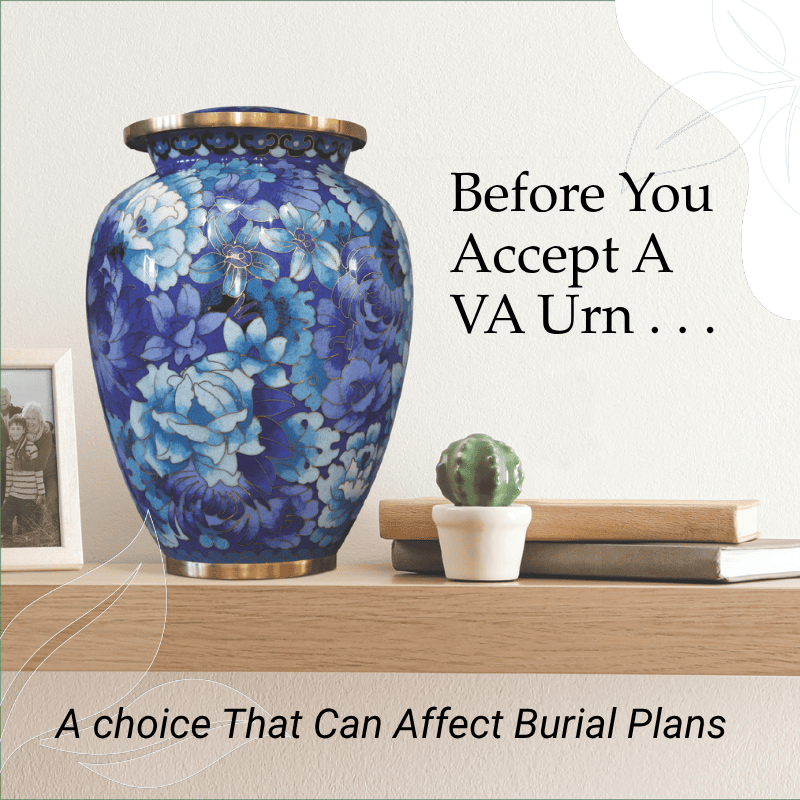
An urn rests at a location. A family has an intention. Sometimes the two are not the same.
For veterans’ families, that gap matters. If a family requests an urn or commemorative plaque from the VA, the veteran will no longer be eligible for burial in a VA national cemetery, and the VA cannot provide a government headstone, marker, or medallion, even at a private cemetery. For a couple hoping to rest together, that can be a painful surprise.
An urn resting on a bookshelf may be exactly where a surviving spouse wants it to remain. Or it may be a comforting presence at home until a promise can be kept: once both spouses have passed away, their remains will be placed together. Either way, the urn looks the same. The intention behind it is different, but the VA’s rules can quietly undo that intention.
Under current federal law and VA policy, when a family requests a VA-furnished urn or commemorative plaque, the veteran forfeits burial in a VA national cemetery. The veteran also forfeits a government headstone, marker, or medallion, even in a private cemetery.
A few terms, in plain language:
Families submit an application for these items from the VA. They are not provided automatically. Submitting that request finalizes the decision. Something many families do not realize.
As the Cremation Association of North America (CANA) explains, Congress created this benefit to give cremation families a dignified memorial item as an alternative to a government-furnished headstone. But the law assumed that families accepting an urn or plaque planned to keep the remains at home permanently. So the benefit was written as an alternative to burial benefits, including the option for burial in a national cemetery.
Real life is different. Families often keep cremated remains at home as a temporary measure, until they are ready to decide what comes next. Many spouses keep an urn at home as a comforting reminder of a loved one until they can both be placed together. To these families, a memorial item and a cemetery placement feel like two separate decisions: one about honoring a loved one now, the other about where a loved one’s final resting place is. The benefit rules connect those two decisions.
This matters most for couples. A surviving spouse may have earned the right to burial in a national cemetery, but if the veteran is no longer eligible, the couple cannot be buried together there. This can be devastating for a couple whose most personal wish was to rest side by side.
CANA reports that the U.S. Senate Veterans’ Affairs Committee recently asked for help raising awareness of a legislative fix. CANA describes the “Ensuring Veterans’ Final Resting Place Act” as a bipartisan provision within the broader “Take Care of America’s Veterans Act.” According to CANA, if it passes, families who choose a VA-furnished urn or plaque would still be able to place the veteran in a national cemetery next to their spouse, and the veteran would remain eligible for a government headstone or marker and other VA burial benefits.
As of September 2026, Congress is still considering the legislation, and it has not become law. Therefore, families should not treat it as a benefit that is already available and should confirm current VA requirements before making any arrangements.
Cremation gives families time, and a lasting place for a loved one’s remains is an option worth planning for. A little planning today can protect a family’s wishes later.
Plans like these do not put a deadline on grief. They simply preserve information and wishes that others can understand and carry forward.
At Arlington Memorial Gardens and Funeral Home, we believe clear information is essential to caring for families. Whether your plans involve a national cemetery or a resting place close to home, understanding how benefit choices connect to future arrangements can help protect what matters most to you. Because an urn on a bookshelf cannot tell anyone what a family intends.
Call us. Our team is glad to talk through any of these options with you.


